Marine cranes are essential lifting devices used on ships, offshore platforms, and dockside operations for handling cargo, equipment, and subsea components. These cranes are engineered to operate safely and efficiently in harsh marine environments, offering durability, stability, and precision even in rough sea conditions.
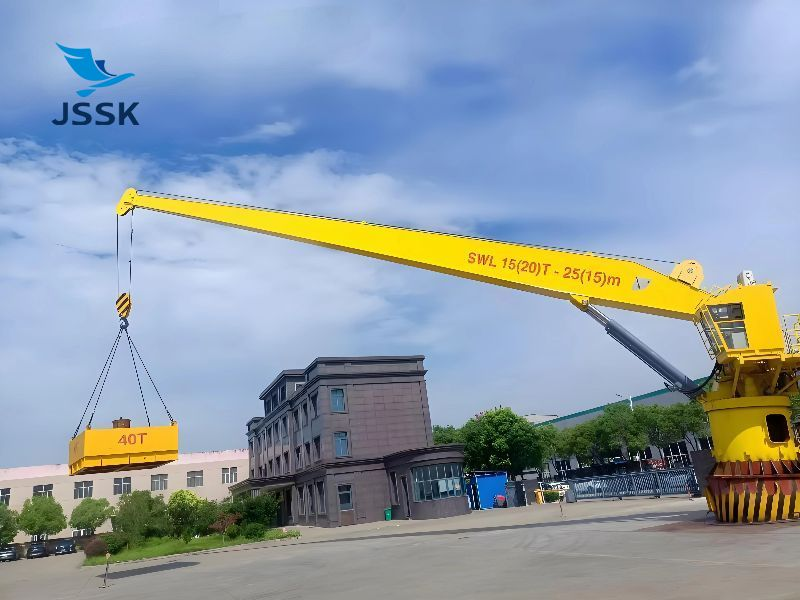
A marine crane is a heavy-duty lifting system designed specifically for marine and offshore applications. It performs essential functions such as loading and unloading cargo, handling subsea equipment, and supporting offshore construction or maintenance. Compared with land-based cranes, marine cranes must withstand corrosion, motion from waves, and strong winds.
Marine cranes come in various configurations based on their design and application — the most common being fixed boom cranes, knuckle boom cranes, and telescopic boom cranes.
A fixed boom crane has a rigid, non-articulating boom structure. It provides high lifting capacity and excellent stability, making it ideal for tasks where reach and flexibility are less important.
A knuckle boom crane features an articulated arm that folds like a human finger joint, allowing compact storage and enhanced maneuverability.
A telescopic boom crane includes extendable sections that slide in and out, providing adjustable reach and height.
Marine cranes use hydraulic or electric systems to power lifting, rotation, and boom extension. Hydraulic systems are preferred for their smooth operation and ability to handle heavy loads. The crane’s control system ensures precise movement, while safety features like overload protection and anti-sway technology enhance reliability during dynamic operations at sea.
Q1: What is the difference between offshore cranes and marine cranes?
A: Offshore cranes are designed for installation on oil platforms or offshore wind farms, while marine cranes are used on ships or at docks. Offshore cranes typically handle heavier loads and operate in harsher conditions.
Q2: How is a marine crane maintained?
A: Regular inspection of hydraulic systems, lubrication points, cables, and corrosion protection is essential. Periodic load testing and preventive maintenance ensure long-term performance.
Q3: Can marine cranes operate in rough sea conditions?
A: Yes. Modern marine cranes are equipped with motion compensation and anti-sway systems to maintain stability during vessel movement.
Q4: What factors determine the right type of marine crane?
A: The selection depends on vessel type, load capacity, reach requirement, operational environment, and available deck space.
Q5: Are telescopic boom cranes better than knuckle boom cranes?
A: Not necessarily. Telescopic boom cranes offer variable reach and simplicity, while knuckle boom cranes provide better flexibility in confined spaces. The best choice depends on the specific application.
Marine cranes are vital assets for offshore and maritime operations, ensuring safe and efficient lifting of heavy loads in demanding environments. Whether using a fixed boom, knuckle boom, or telescopic boom crane, the right choice enhances operational safety, efficiency, and performance at sea.
